Journey to the motherland: in pictures
11 Saturday Apr 2009
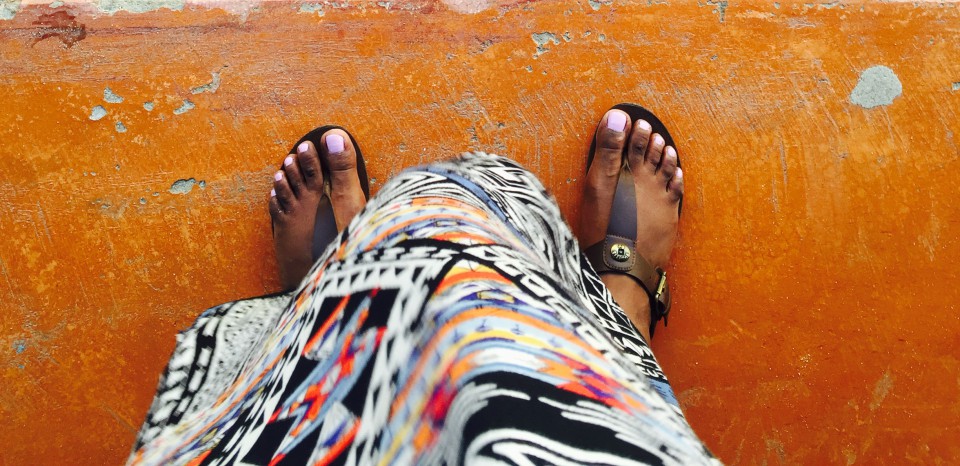
11 Saturday Apr 2009
10 Friday Apr 2009
Tags
Once we passed Al-Seliem Basin, the paved road ended and we reverted to using dirt roads. I was astonished once we entered regions passed Abu Fatma. The familiar desert topography that I had in mind faded, to be replaced by desolate and never-ending string of mountains and valleys. I was astonished at the sights before my eyes; I truly thought the only significant mountains in Sudan were to the West, in the Jabal Marra region. Only then did I begin to get an appreciation of the hardships faced by family members traveling to and from Khartoum to Al-balad (region of origin). The drive was backbreaking and this was felt from the comfort from our fully air-conditioned 4wheel drive land cruiser. So I could only imagine how much tougher it was in the Nissan buses that occupy this route. The roughly 280km from Dongola to Abri was covered in over 4 hours.
We arrived in Abri late in the evening and we pleasantly greeted at the DAR Consulting Guest house overlooking the Nile River and directly across from Arnata. From the numerous tales I had heard of the region, I imagined entering a completely pitch-black region, yet another contradiction was the enchanting dots of light that lit our path. Electricity which was once a luxury in this region seems to have been made accessible, in Abri at least. The guest house we stayed at, which I was told was designed and constructed by an Arnata native son was quite impressive. Definitely not the type of lodging you would expect in Abri of all places. It is definitely on par with some of the finest hotels in Khartoum.
Exhausted from the trip, we called it an early night in eager anticipation to finally see Arnata. The next morning I awoke and looked out my window to finally realize the island of Arnata is directly in front of our view. The weather was chilly, much chillier than I anticipated. A warm cup of tea and we were off to find a way to cross over and finally see that island that has captivated me. After arranging for a boat to help us cross over, we hesitantly wobbled down the steep embankment that contoured the banks of the Nile River.
Half way across the river, among a few men standing at the top of the embankment in Arnata, was my great-uncle. His boisterous laugh could be heard from a distance, as he waved his arms to greet us. As we arrived, I took a good, long look at the embankment we were about to climb; the equivalent of a 1 storey building, nearly vertical and composed of soft, silty unstable soil. The imposing climb made sympathize with those who use it on their daily route to and from the island. A few minutes later we were on solid ground among the wheat and fava bean harvests. The soft greenish-yellow stalks of wheat waved to and fro with the gentle gusts of wind. With each step our feet sank into the dark, fertile soil. Abruptly the arable plots of land were interrupted by sand dunes. Although not suitable for farming, these golden sand dunes sustained flourishing date trees. A short climb over the dunes and houses came to full view.
Neatly aligned houses overlooking central squares filled the landscape. Constructed of mud aggregate as a cooling mechanism as weather in these regions tend to be among the hottest on earth. The mud as opposed to conventional building materials tends to bring higher degree of relief from the scorching sun. Especially since electricity is scarce and fans or cooling systems are virtually nonexistent on this island. From a distance one would could not even tell the difference in building materials, as special care is taken to erect the houses and polish them with fresh coats of paint.
Upon arrival at my greatuncle’s house we were greeted by a host of extended relatives. Some of which I had previously met, others it was a first time encounter. Our time was very limited despite their persistent efforts to persuade us to stay and have something to eat and drink, we wanted to cover as many houses as possible. So with a second cousin as our guide we quickly mapped out the houses of extended family we wanted to visit and got on our way. With each house we entered, looks of bewilderment and surprise were painted on their faces. I was the last person they expected to see. At each stop it was a struggle to persuade them that our time was limited. All wanted to honor our presence by having us over for a meal. Regrettably, time did not permit. Still processing our arrival, family members left what they were doing and joined in an ever growing procession across the island to visit other relatives. The sounds our laughter and chatter grew in size and even those who we were not planning to visit peeked outside their doors to find out what was going on.
It was a very short and bittersweet trip. At that point in time I seriously contemplated telling my aunt to carry on further up north with her work as planned and I would find other means of getting back down to Khartoum. Alas reality brought me down to earth and reminded me of my obligations to work and family back in Khartoum. We were whirled off in the same frenzy that brought us onto the island but this time with throngs of relatives bidding us farewell.
04 Saturday Apr 2009
Posted in Sudan
Tags
Still reeling and trying to internalize the events from my last trip to El Gadarif and the Ethiopian border, I got the chance to go to the tiny island of Arnata, where my mother’s family is from. It was an opportunity I had been chasing for sometime but lacked the motivation as no one was keen on accompanying me. Luckily for me my aunt had a preplanned trip to the region to report on the progress of the Al Seleim-7alfa-Gustul, Egypt road that is currently in development. I jumped at the chance and packed my bags within hours of the news eagerly anticipating the journey. To give you an idea of the regions traversed during this trip, take a look at the map below:
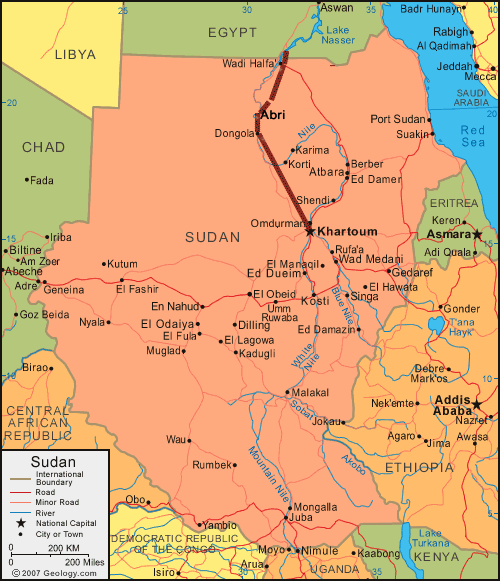
The first leg of the journey from Khartoum to Dongola (roughly 500km) was a breeze thanks to a relatively new paved highway that connects the 2 cities. The five hour journey led us into Dongola right around lunch time. We made a pit stop to eat, rest and accompany my aunt on some work related meetings. Up until this point the topography of the region validated my mental image of the deserts of northern Sudan. Large breaks of sandy dunes with a solemn mountain/ rock formation in the distance. For the most part it resembled regions of River Nile State, similar to what I saw along the way to my trip to Abu Hamad. (and the island of Mougrat). The paved road passed Dongola extends a few more kilometers to cover Al-Seleeim region. Beyond that point we entered new territory.
I was taken aback by the city of Dongola. To be honest I really didn’t expect it to resemble a city at all but instead had the image of a large village in mind. I was pleasantly surprised to enter a meticulously organized city with particular care from local authorities to keep the maintain the greenery that adorned its streets. My stay in Dongola was brief, so there isn’t much I can say about the people as I did not have much time for interaction.
23 Monday Mar 2009
For the past few days, I’ve spent the majority of my in the village of Kunaina Albeer, located on the Sudan-Ethiopia border. A mere 10 km away, and one would be walking on Ethiopian soil and all that seperates the two nations is a mere seasonal gorge that is dry most of the year.
The 140km trip from the city of El Gadarif, the prominent thatched huts that are indigenous of this region come into full view. Although labelled as a village, Kunaina is more like a small town with over 8,000 inhabitants and a sizable local market. It’s an interesting village, one that surprisingly has high representation of various ethnic groups from across Sudan. Many came and settled for agricultural purposes. Others such as Huasa and Fulani (known as Falata in Sudan) groups with roots in West Africa (Nigeria, Ghana,etc) crossed the continent on route to Mecca and have since settled and became integrated into the melting pot of Sudanese society. These groups in addition to ethnic groups from Northern and Western Sudan along side numerous Ethiopians and Eritreans who also now El Gadarif home.
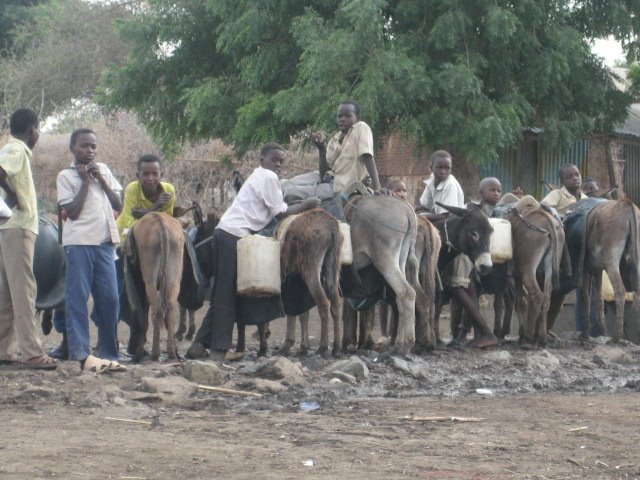
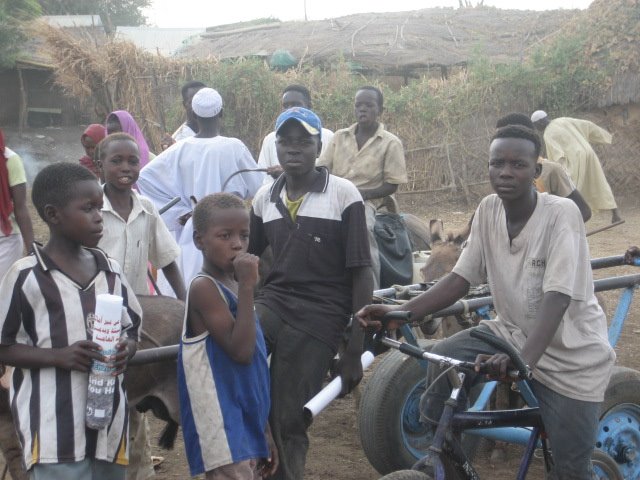
Most of the time was spent in the vicinity of the water station. Although not a watering hole, residents living on the outskirts of the village come into the water station to fill up. It’s mostly kids who were present collecting water. So by default it has become the local hangout spot. So with donkeys in tow children and teens line up and chat while filling up their water containers/ bags. Talks these days surrounded the exam timetable for some and the grueling load of memorization that awaits them. Others with their minds elsewhere, were discussing means of upgrading or buying bikes. A few had their heads in the clouds discussing, mobile phones they have seen some village elders carrying.




19 Thursday Mar 2009
Posted in thoughts, world water day
Tags
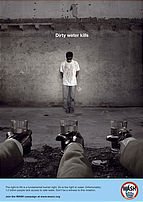
So many of us take for granted clean water and somewhere to go to the bathroom, but the reality is that the vast majority of the world’s residents, Sudan included lack access to these basic services. At that, the world’s water resources are rapidly being polluted. As an african proverb stated in the post title says it appropriately points out that dirty water cannot be washed.

World Water Day- March 22 will be celebrated worldwide this year on this coming Sunday. Currently in the process of celebrating this day and bringing to light the monumental issues facing billions of people worldwide. This year the international theme is trans-boundary waters-shared waters, shared opportunities. Nationally, alongside the international theme, it has been decided to add additional messages to suit WASH initiatives. The national slogan is “Share the responsibility for the management of water sources and sanitation promotion” This year the national program will take place with promotional programs in El Gadarif (in Eastern Sudan). The Water Supply & Sanitation Collaborative Council (WSSCC) has a great campaign materials to highlight this sectors burgeoning problems:


07 Saturday Mar 2009
Posted in thoughts
The ICC officially issued its arrest warrant for Sudanese President Omar Al-Bashir last Wednesday around 4pm Khartoum local time. The wearily anticipated news has had everyone on edge for some time now. Some fearing violence would erupt immediately after the press conference. Thankfully, no violence, just thousands of people out in a government organized protest in central Khartoum. Thursday was followed by more protests that drew even larger crowds. All government offices were given the day off and were highly encouraged to attend these protests.
It took me a couple of days to sit down and write this because I wanted to get a feel for various murmurs and whispers that underlined the roars of Al-Bashir supporters. It’s all over the headlines; every major news agency has covered the immediate reaction of the government and Bashir’s defiant dance to the West.
The general consensus here in the capital is that the issuance of this warrant is regrettable. Not necessarily because they are sympathetic with the president but more so worried about the outcome of this event. Many fear that this will lead Sudan into a downward spiral with its citizens bearing the brunt, particularly those in Darfur.
As someone who grew up in the West, I could understand how someone outside this country can see it in black and white….yes Al-Bashir should be tried at the ICC. But having spent time here working, I have begun appreciate the point of views of citizens of this country. I cannot say that there is a homogenous Sudanese point of view, but getting the chance to hear varied voices has led me to reevaluate this situation. The situation is far more complex and a message such as the ICC’s indictment has some serious consequences. From a western point, the approach to this entire situation is 1 dimensional. I would say many of the repercussions of this indictment were not fully accounted for.
Politics and self-appointed political figures and pundits aside, the voices of regular citizens speak volumes and shove all the propaganda aside. From what I have gathered even those who strongly opposed Al-Bashir and his regime, are not in favor of the ICC’s decision, for the following reasons:
Although the ICC’s chief prosecutor Luis Moreno-Ocampo, now a household name in Sudan stated the greatest implication of this warrant will fall on Al-Bashir himself as it will restrict his international travel, many see that will not be the case. The ICC has no enforcement powers and many countries are not signatories of the Rome Stature, which created the ICC in the first place. Many believe the ICC and “Ocambo” are “not firmly planted on the ground” implying that they are not being realistic to believe that Sudan will comply and hand over Al-Bashir, especially since they have already vehemently refused to turn over 2 other government supporters/officials heavily implicated in the Darfur crisis.
What is more unfortunate and appalling is the government’s decision to expel 13 NGOs, which were some of the most active in delivering basic needs and services to hundreds of thousands of people. For someone how is currently working in the development sector this decision is making my head spin. Really I cannot fathom how the government or the remaining agencies will be able to fill the gap of those who were expelled.
In talking to friends and acquaintances in some of the expelled NGOs, the mood is frantic and melancholy. The means by which the government went about expelling these organizations is uncalled for. Many have had many of their possessions seized, not even being able to take paper from their offices….. they were told to evacuate immediately. But even that could not happen as many who made it to Khartoum are currently waiting to get exit visas, which are complicated further by the cumbersome government bureaucracy.
I really do hope the government rethinks this decision as it is detrimental to the well being of hundreds of thousands if not millions of Sudanese citizens. When Sudan’s issues were brought to the international stage, I was excited as it finally highlighted the plight of millions who could not properly voice their situation. The past 2 years in particular were good in the sense that the government began to take notice and allocate funds to alleviate the suffering of those disenfranchised citizens. These past few years saw some progress in roads to inaccessible regions, funds to establish and strengthen government sectors working in developing the underdeveloped regions of the nation. The means by which the international community has applied pressure in recent years has helped the situation somewhat.
Sadly the ICC’s indictment has set the nation on the path to taking ten steps backwards….after its first step forward.
24 Tuesday Feb 2009
Posted in thoughts
Tags
rough translation: the safe path is closer to the new year
meaning/usage:take the known (safe path) which will ensure you make it to the new year (live longer), rather than taking a short cut (dangerous/unknown path) and putting yourself in danger.
23 Monday Feb 2009
Posted in thoughts
Tags
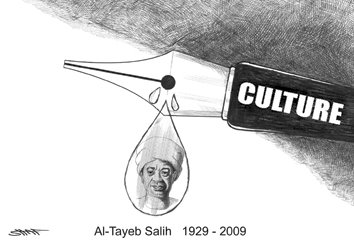
I have been meaning to write this post for a few days now to pay homage to Sudan’s more ubiquitous literary figures… Mr. El Tayib Salih. I’ve been swamped lately but needed to get this post through. Mr. Salah passed away on Feb. 18th at the age of 80 in London after a long battle with kidney complications.They say a picture says a 1000 words, and the Saudi Gazette summed up this loss so beautifully:
For me this author really helped me define my Sudanese roots and opened a door to my heritage that I lacked growing up outside the country. Although he published numerous novels and short story series, I have only gotten the chance to read 2 thus far; his most renowned book “Season of Migration to the North” and “Wedding of Zein”.Mr. Salah was born in Northern State, Sudan and travelled to London to continue his studies. As a result his book Seasons of Migrations draws heavily on his experiences of trying to reconcile two very conflicting cultures and realities. His work is a bold post-colonial statement that took me, as it did for many other readers, along for a journey where the young character is caught in the cross-waves of small, conservative agrarian society and the urban sprawl and ever expansive reach of Western Culture. This book was once declared “the most important Arabic novel in the 20th century”. Unfortunately his great work was never properly given its due, where many called for Mr. Salih to receive a Nobel prize for his exceptional work.Wedding of Zein, which is a collection of 3 stories (Wedding of Zein, A Handful of Dates & The Doum Tree of Wad Hamid). This collection, for me was much more powerful as it provided me with a compelling glimpse of traditional eccentricities of “al balad” the home country or indigenous culture. Despite its accurate portrait and specific descriptions of traditional Sudanese society, it has a universal feel. In the end they are small town folk, that can be anywhere around the world. The themes that are intertwined in these “folktales” can strike a chord with any reader, anywhere.The meticulous descriptions of the characters made me believe as my grandmother was sitting and narrating the tales of Zein and his tribulations to win Ni’ma’s affections.He is an iconic Sudanese figure, that truly gives and exemplary representation of Sudan and its people. At a time when this nation is known for civil wars, displaced peoples and oh so many political shortcomings, it is figures like El Tayib Salah that speak out for the voiceless peoples of Sudan. For that we owe him a so much gratitude.Allah yar7amak….
17 Tuesday Feb 2009
Posted in thoughts
Sudanese as a people are the biggest propagators of gossip. It seems that the entire nation is playing a long game of “telephone” where a fact or myth is modified a million and one ways. The result is a hodgepodge of hearsay and rumors.

Most of which are rooted in facts that have some validity but the extent to which the actual fact has been distorted is hard to estimate. So I have learned to take whatever I hear with a grain of salt, as there is bound to be someone out there who added a bit or deducted something from the original fact, or made it up to begin with.
These days a stormy cloud of uncertainty hangs over the nation. With the imminent indictment of the Sudanese President, Omar Al Bashir by the International Criminal Court (ICC), everyone here seems to be on their toes, especially those in Darfur. So through the grapevine, stories are circulating that once the official indictment is made public armed militias have been given orders to attack UN agency staff and related NGOs. As a result expatriate staffs are being told to prepare for the worst and expect immediate withdrawal from the Darfur region. There is no way of validating this fact. It could be completely fabricated. Regardless, no one is taking this threat lightly and are consequently preparing for what could happen.
Meanwhile, across the Red Sea in the Qatari capital, Doha talks have been taking place between Sudanese government officials and Justice and Equality Movement (JEM) members. News reports have indicated that both groups have reached a preliminary peace agreement, brought on by intense international pressure. The timing of such talks are uncanny, no telling if this will have any impacts of the ICCs decision to bring Al Bashir’s case to court.
14 Saturday Feb 2009
Posted in Travel
Among the numerous ethnic groups/tribes in the Kassala region, one I was particularly intrigued by was the Rashaida; sometimes referred to as Zebedia. This tribe traces its origins to the Arabian peninsula from which they migrated over a century ago. They claim to be ancestors of Haroon Al Rashid, some argue that their lineage stems from his wife Zubida. They are offended if you refer to them as Zebedia.
Although many centuries have passed, they have managed to grip onto their way of life and culture. They still maintain their nomadic lifestyle. Their Arabic accent is akin to those dialects of Gulf nations (Saudi Arabia, UAE, Yemen, Bahrain, Kuwait, Oman). Their women always veil their faces in public. As a people they are fairly secluded and rarely marry from outside their ethnic group. Never really live in cities or urban areas and only enter Kassala proper to obtain goods, food, etc. Although, in recent years I have been told they started opening up to people and cordially interact with other ethnic groups in the region. They have increased their contact with people of the outside their circle.
As you enter Kassala you begin to see their settlements, usually a series of tents. They are a relatively wealthy tribe as they many are involved in smuggling of counter-bands. So their dwellings have been upgraded with the addition of satellite TVs and their preferred mode of transport, which in most cases are land cruisers or pickup trucks. Top of the line of course. I kid you not, as we drove each settlement of tents had a fairly brand new 4 wheel drive vehicle or pickup truck. It was such an odd paradox.
[gigya type=”application/x-shockwave-flash” src=”https://static.googleusercontent.com/external_content/picasaweb.googleusercontent.com/slideshow.swf” width=”500″ height=”300″ flashvars=”host=picasaweb.google.com&hl=en_US&feat=flashalbum&RGB=0x000000&feed=https%3A%2F%2Fpicasaweb.google.com%2Fdata%2Ffeed%2Fapi%2Fuser%2F107129263791403689175%2Falbumid%2F5301851211570504097%3Fkind%3Dphoto%26alt%3Drss%26authkey%3DGv1sRgCN-e5OfYytL3rQE” pluginspage=”http://www.macromedia.com/go/getflashplayer”%5D
 nubiaNomad