• About

nubiaNomad

~ happenings & reflections

nubiaNomad

Author Archives: nubiaNomad

A tasty bite of Kassala

14 Saturday Feb 2009

Posted by nubiaNomad in Travel

≈ Leave a comment

Tags

Kassala, souq, Sudan, Toteel mountain

Toteel:
We met up with the rest of our group at the cafe near the base of Toteel Mountain. A pleasantly arranged set of cafes huddled on large rock formations. Of course coming to Eastern Sudan and not tasting coffee is missing out on oh so much. Neighboring the region that discovered coffee, you better believe coffee culture is serious business around these parts. Many of the ethnic groups Beja (mainly comprised of Beni Amer, Hadandawa and Halanga in addition to a myriad of other smaller tribes) roast, grind and brew their own coffee on the spot. Many carry around with them miniature mortar and pestle in order to grind the beans. Freshness is key.

So we climbed up to the base side cafes and decided to climb further to get a panoramic view of the city. Our climb took us to the Well of Toteel, a ground water aquifer that is recharged by rains, is a famous well. Locals say that if you drink from Toteel’s water you are bound to return. So of course we abided by our hosts request to have a some water in order to ensure our return. Once we soaked up the majestic view of the city and all the way to the empty Gash River basin, we walked down to one of the cafes and ordered some coffe. They really do know how to brew some good coffee. We stayed at the café and watched the sunset, with its vivid streaks of oranges and yellows painting the sky. After which we headed down towards the city to took yet another prominent region of the city.

[gigya type=”application/x-shockwave-flash” src=”https://static.googleusercontent.com/external_content/picasaweb.googleusercontent.com/slideshow.swf” width=”500″ height=”300″ flashvars=”host=picasaweb.google.com&hl=en_US&feat=flashalbum&RGB=0x000000&feed=https%3A%2F%2Fpicasaweb.google.com%2Fdata%2Ffeed%2Fapi%2Fuser%2F107129263791403689175%2Falbumid%2F5301853950987497553%3Fkind%3Dphoto%26alt%3Drss%26authkey%3DGv1sRgCNHk9uHb4ayV0AE” pluginspage=”http://www.macromedia.com/go/getflashplayer”%5D

Al Sawagi:

Al Sawagi are a series of family owned orchards that line southern end of the city, along side of the Gash River Basin. The orchards extend for miles and grow a multitude of fruits and veggies including the famous Kassala “dotted” bananas. We drove along a 2 story high flood prevention dam that is meant to protect Al Sawagi’s residents from the wrath of the Gash River. Driving along the orchards the air was fresh and clean, and much cooler than the temperatures in the city. We drove to a look out point, overlooking the empty Gash River basin and the mountains in the distance. At sunset, the view was surreal. When looking at the pictures taken at this location. It is as if, my colleagues pictures were photoshoped behind this backdrop.

Soug Kasala:
We hit the souk to get a taste and feel for pulse of the city. At night the souk is more effervescent. The rhythms of cars, vendors, music from shops and the mundane movement of people coalesced melodiously to generate a unique and pleasant soundtrack. The auditory experience was further enhanced by the distinctive smells of spices, coffee, incense and food freshly prepared by street “hawkers”. Each regional city’s central souk has its unique features but Kassala’s souk is a different world. One that not only blends the goods of the colorful ethnic groups in the region but also numerous shops of Kassala’s sizable Indian population. Indians here specialize and are well known for their Sari and textile shops. Most women purchase the Saris and wear them as our traditional Toubs. They are for the most part the same length. We zigzagged through various shops, mingling with the Indian owners to find good bargains. It was a really interesting case study to see how these Indians have assimilated into Sudanese culture. Yet at the same time maintained to retain their distinct Indian heritage. Their connection with their homeland is evident with the numerous Bollywood posters that decorated their shops in addition to pictures of devoted gods. Although walking through the souk and taking in first hand the interesting menagerie of shops and peoples, I quickly grew tired of looking at goods. I bought a few things early on but was obliged to continue through the maze of shops as others with me were still in the process of making purchases. After a long and exciting day, we bid farewell to our hosts who graciously chauffeured us around and showed us some of the best their city had to offer.

Upon our return to our guest house, we were greeted by a peculiarly organized poetry reading session. To be honest we were exhausted at this point, but at the insistence of the owner’s numerous requests, we appeased him by sitting in and listening to some of the poetry. After which we called it a night.
Share this:

  • Click to email a link to a friend (Opens in new window) Email
  • Click to share on X (Opens in new window) X
  • Click to share on Facebook (Opens in new window) Facebook
  • Click to share on Pinterest (Opens in new window) Pinterest
Like Loading...

Seedi Hassan

12 Thursday Feb 2009

Posted by nubiaNomad in Travel

≈ Leave a comment

Tags

Kassala, Khatmia, Sayid Hassan Mosque, Sudan

Day 2, started off with the continuation of the workshop. After the conclusion of the workday, this wrapped up early around 3pm. We were invited to a meal by our Kassala counterparts for all the workshop participants. The meal was organized in one of the many orchards in the city. Somewhat similar to our outing in Kadougli, but here we had an uninterrupted view of Taka and Toteel Mountains. The backdrop this chilled out finale of our work.

We decided to make the most out of our time and immediately after the meal our hosts were eager to show us around. We hopped into our cars and began our tour.

Sayid Hassan Mosque

At the foot of Jabel Toteel, is the ancient mosque of Sayid Hassan (referred to as Seedi Hassan). The unroofed mosque is centuries old and houses the remains of Sayid Hassan in a “darieeh” or a mausoleum type structure. Residents of this region of sufi pilgrims travel to come pay their respects to Sayid Hassan. In addition to paying their respects many vie to obtain a bit of sand that covers the ground of the mausoleum.

The structure is quiet spectacular. Remains of wooden planks bulge out from the structure. These wooden posts were used as ladders to stand on during the building process. Legend says, that although the mosque is unroofed that it rain never falls down onto the inside of the structure.

Walking towards the mosque, a feeling of bewilderment at how this structure was erected and how it stands side by side of the mountain, as if challenging the Toteel submits’s height. It’s a pure show of audacity and boldness. The structure itself was created from simple copper-toned bricks and the pillars seem to have been of marble or a finely polished caramel-colored granite rock.

To pay our respects we took off our shoes, prior to entering the compound of the mosque and walked over the hot, grainy sand towards the part of the mosque that housed Seedi Hassan’s remains. After walking in and sending a few minutes with that structure we toured the remainder of the mosque. The structure is largely unused but during large festivals (Eids), the mosque is used for regular prayer services and its largely vacant lots are packed with followers and parishioners.

[gigya type=”application/x-shockwave-flash” src=”https://static.googleusercontent.com/external_content/picasaweb.googleusercontent.com/slideshow.swf” width=”500″ height=”300″ flashvars=”host=picasaweb.google.com&hl=en_US&feat=flashalbum&RGB=0x000000&feed=https%3A%2F%2Fpicasaweb.google.com%2Fdata%2Ffeed%2Fapi%2Fuser%2F107129263791403689175%2Falbumid%2F5301858116214376241%3Fkind%3Dphoto%26alt%3Drss%26authkey%3DGv1sRgCK-w4qm5q92-nQE” pluginspage=”http://www.macromedia.com/go/getflashplayer”%5D

Share this:

  • Click to email a link to a friend (Opens in new window) Email
  • Click to share on X (Opens in new window) X
  • Click to share on Facebook (Opens in new window) Facebook
  • Click to share on Pinterest (Opens in new window) Pinterest
Like Loading...

¨for you Kassala, I fell in love¨

09 Monday Feb 2009

Posted by nubiaNomad in Travel

≈ Leave a comment

Tags

Gadarif, Kassala, Sudan

This time, work took me to one of the most eastern regions of Sudan. Kassala is a popular local tourist destination, oddly with a disproportionate percentage of newlyweds. Many come to be enchanted by the mesmerizing Taka and Toteel “sugar loaf” mountains.

The post title “for you Kassala, I fell in love” is a rough translation of famous song lyrics that signify that one fell in love just so that he can come with his loved one to Kassala to share in its natural beauty.

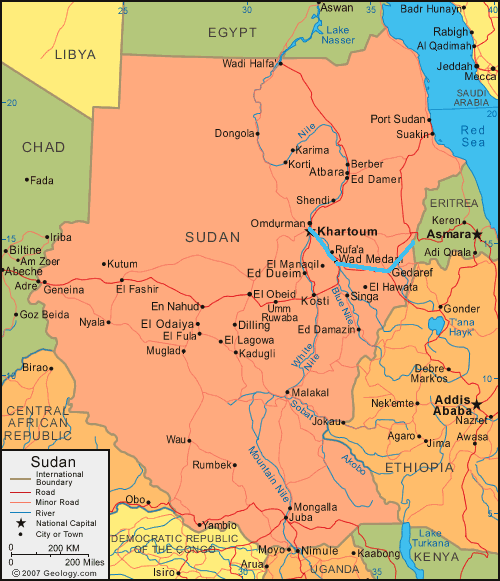
The city of Kassala is on the border with Eretria, roughly 4 hours away from Asmara. It is about 600 km east of Khartoum. The city is split in half by the merciless Gash River. For most of the year the Gash River basin is a sandy, dry gorge that overwhelmed by water pouring down from the Ethiopian and Eritrean highlands during the rainy season. Unlike other seasonal rivers in the region, like the Atbara River, the Gash River has a habit of continually changing course and wreaking havoc on the city’s residents.

We started off on the wrong foot by leaving relatively late in the afternoon for our trip. Mid afternoon heat waves indicated that it would be a long journey. Leaving Khartoum, we took the familiar path towards Wad Medani in Gezira State (southeast of Khartoum). From Wad Medani we broke eastwards heading towards Gadarif State. Unfortunately along the way, the intense heat left its mark on our car. Till this point we were relatively unaware of the extent of the heat from the comfort of our fully air conditioned car. After crossing Gadarif state borders, our car started to show signs of fatigue. First our air conditioning system gave way, then the engine itself began to wail. The parched engine quickly evaporated all our excess water supply. In an effort to remedy the situation even our drinking water was exhausted in the process of cooling the engine. We finally gave way and stopped the car for some time. When this procedure led to limited success, we began driving slowly till we lucked out on an agricultural camping post. There we were saved by 2 generous guys who supplied us with water to remedy the situation. To give you an idea of the course travelled, take a look at the map below.

We hit the road again and made a pit stop in the outskirts of El Gadarif for food and prayer. From there we cruised into Kassala fairly late in the evening. Even in the midst of night, the prominent mountains stood in a dark haze, as though keeping watch on the city’s dwellers and visitors. The breeze was cool and refreshing a welcome change from the heat we were exposed to throughout the trip. The lush green savannahs juxtaposed to the Ethiopian highlands have a special blend of scents and gentle winds that are very welcoming and comforting to any newcomer.

Exhausted from our 11 hour journey, we made our way to our guest house and after settling in crashed for the evening. A long day awaited us in the opening day of our Eastern Region workshop.

Today the workshop started with the same routine followed in previous sectors. Members representing all institutions/ entities in the WASH sector in this region congregated to discuss and review the policy at hand and lend voice their concerns and suggestions. I stole away in the late afternoon in a gap where, with access to internet to update on my first leg of the journey. We shall see what else the lies ahead today….

Share this:

  • Click to email a link to a friend (Opens in new window) Email
  • Click to share on X (Opens in new window) X
  • Click to share on Facebook (Opens in new window) Facebook
  • Click to share on Pinterest (Opens in new window) Pinterest
Like Loading...

loss

03 Tuesday Feb 2009

Posted by nubiaNomad in thoughts

≈ Leave a comment

For the better part of this month, the thought of sitting down at a computer or even putting together coherent thoughts in a blog was out of the question. It was the first time for me to lose someone close, the process of trying to internalize and process the events taking place were somewhat surreal. At times, it felt like I was watching a movie and it will soon end… to some extent it still does. Having received the dreadful news of my cousin’s death in the early days of the new year, 2009 was forever marred with unpleasant memories. To make a difficult situation even more difficult was the process of trying to release his remains and bring them to Sudan for a proper burial; a wake, which was to last 3 days at most lasted nearly 3 weeks. I do not want to dwell on the events and what could have been. It is still somewhat difficult to process that I will never see him again.

I am thankful a good portion of my family was here or flew here to be together during this dreadful time. Their strength and solidarity has definitely helped in pulling our family together and shielded us this shattering event. I have come to realize that during moments of atrocity, one’s true nature shines through. Having time to reflect on what took place, along with my grief, I am in awe of my family for pulling together and supporting each other. Each and every one of them is uniquely beautiful and I am thankful to have them.

With time, I hope that it will become easier. For now I ask god to provide us with patience to move on. He is constantly in my prayers and I hope he rests in peace. I ask god to give my aunt to deal with this tremendous grief, as I can only imagine how hard it is to lose a loved one, let alone a child.

I will try bit by bit to get back to blogging as I start to regain some sense of “normalcy” in my day-to-day activities.

Share this:

  • Click to email a link to a friend (Opens in new window) Email
  • Click to share on X (Opens in new window) X
  • Click to share on Facebook (Opens in new window) Facebook
  • Click to share on Pinterest (Opens in new window) Pinterest
Like Loading...

A glimpse of Kordofan

04 Sunday Jan 2009

Posted by nubiaNomad in Travel, Uncategorized

≈ Leave a comment

Tags

El Obied, Kadugli, North Kordofan, South Kordofan, Sudan

Here’s a glimpse of Kordofan (North and South). Uploading the photos took forever so this is what I could get around to uploading. Hopefully I’ll try to put up more if possible.

[gigya type=”application/x-shockwave-flash” src=”https://static.googleusercontent.com/external_content/picasaweb.googleusercontent.com/slideshow.swf” width=”500″ height=”300″ flashvars=”host=picasaweb.google.com&hl=en_US&feat=flashalbum&RGB=0x000000&feed=https%3A%2F%2Fpicasaweb.google.com%2Fdata%2Ffeed%2Fapi%2Fuser%2F107129263791403689175%2Falbumid%2F5287441923688403553%3Fkind%3Dphoto%26alt%3Drss%26authkey%3DGv1sRgCLrdle7O656CtQE” pluginspage=”http://www.macromedia.com/go/getflashplayer”%5D


Share this:

  • Click to email a link to a friend (Opens in new window) Email
  • Click to share on X (Opens in new window) X
  • Click to share on Facebook (Opens in new window) Facebook
  • Click to share on Pinterest (Opens in new window) Pinterest
Like Loading...

To Kordofan and Green Savannahs

02 Friday Jan 2009

Posted by nubiaNomad in Travel

≈ 1 Comment

Tags

El Dalanj, El Obied, Kadugli, Kordofan, Sudan

For the better part of last week I left Khartoum for Kadougli; a city in South Kordofan State. En route we passed by Kosti (on the banks of the White Nile) and made a pit stop in El Obied (North Kordofan State). Kadougli is roughly 750km southwest of Khartoum. Without stops this trip can most likely take 12 hours by car, but of course pit stops are essential. To give you an appreciation of the distance covered in relation to the size of Sudan, look at the map below.


Thus far my exposure to Sudan geographically has been limited to the North and as far down as the Central region (Gezira State). All for the most part located in the world’s largest desert (Sahara). So I’ve seen my fair share of sand dunes. Close friends often joked that Sudan needs a minister to manage its sand resources. No matter how hard I tried to explain to them that the Sahara covers only a third of Sudan, they were not convinced. During this trip, I waved goodbye to the familiar sand and dust and took a trip down to the savannah. The change in was gradual. Much of Kosti and even El Obied were dry, but I was told in the rainy season these regions bloom.

El Obied is a bustling city, arriving midday we made a pit stop and strolled through the central market, where pretty much anything you can think of you can find; from traditional spices to imported clothes and electronics. Took a quick tour of the city before going to meet our counterparts in El Obied office. One landmark that made a deep impression during my short visit to this city was the city’s church. Its one of the city’s oldest buildings but remarkably it stands as if it was built just a few years ago. It’s sandstone blocks glistened in the sun.

After the short stay in El Obied, we hit the road again towards Kadougli. After leaving El Obied, clear evidence that we have left the desert behind were apparent, expansive grasslands with brief breaks of wooded areas. The further south we progressed, the more amazed that I was still in the same country. Traversing up and down gentle hills that were covered with warm green blanket; a blanket that vibrates with vivid shades of green in the rainy season, it was hard not to be astounded at this country’s natural beauty. Occasionally the prominent Tabeldi tree (Baobab tree) captured my attention, standing proudly. Its gargantuan trunk truly commanded respect. In rural regions across this state where this tree is prevalent and water is scarce several month throughout the year, residents carve out the inside of this tree and use it as a gigantic rainwater storage tank.

Along the way, we crossed the town of El Dalanj, the majority of this town is covered by a canopy of trees. Some of these woods expand well outside the limits of the town. In addition to the natural woods available, there is planned wooded region that was established by the British during their colonial rule. The once juvenile forest during their rule is now a lush thick forest that provides income for foresters in the region and is an excellent source of local building materials. Again, I was truly in awe that I was still in the same Sudan that I associated with dry, harsh and unforgiving sand dunes.

Paved roads extended up until El Dalanj, which made the drive thus far easy. The roads in this region are currently being rehabilitated. El Dalanj marked our entrance into Nuba mountain territory, regions that were ravaged by Africa’s longest civil war. Up until very recently (2003) entry to these regions was fairly difficult and you entered at your own risk. It is clear SLPA/M territory. Past El Dalanj, in addition to entry authorization, one could not progress without escort via armed convoys. Moreover, travel had to be conducted during the daytime. It was vital that one arrived into Kadougli before 5pm. Today, no authorizations or armed checkpoints restrict access as they once did. Unfortunately roughly 130km strip of the road is in dire need of rehabilitation and remainder of the drive into Kadougli is backbreaking.

Kadougli itself is a city cuddled into a valley surrounded mountains. As you entered the city large trees hugged the roads on either side, saying welcome in their own way. Arriving fairly late, the city was vibrating with people sitting around at corner coffee/tea shops or kiosks and moving about.

Our work took good portion of the following 2 days, where there wasn’t much time to explore. Much of what we set out to achieve in the workshop was achieved with surprisingly high turn out and participation from government officials at all levels as well as various stakeholders in the water and sanitation sector.

Unfortunately we did not spend enough time to make it out to Miri Reservoir a favorite local trip outside the city or see Kelbi waterfall. In the rainy season this region comes to life, and an additional number of seasonal waterfalls can be seen from within the city making their way from the mountains that surround the city. Our kadougli counterparts were very hospitable, they refused we leave without at least getting to taste a bit of their heaven. After the completion of the workshop we had an outing in an orchard on the outskirts of the city. Chilled out for the majority of the afternoon under mango groves. Our gathering turned into pre-new years festivities with music blasting and people getting up to dance. The festivities grew in size as more people joined in. Our hosts initiated the party and got people to get up and take part; any small reason was a reason for festivities as if they were making up for lost times when such a gathering could not take place.

It was reassuring to see glimpse of hope in the region and as the rapidly approaching road reaches Kadougli, I am sure residents of the region who have been cut off for so long will once again be connected. There is definitely a feeling of peace and calm in the region and it’s comforting to see that residents of the region have begun to gain some relief. It’s one thing to reflect in such a positive tone but sadly not all regions in this country or this state share in Kadougli’s fortunes. Stability and unrest still plague nearby regions such as Abyie. Regardless of my political views and my skepticism towards all parties/factions within Sudan’s political scene, I do hope that these regions begin to gain stability as residents here have suffered silently for decades.

Share this:

  • Click to email a link to a friend (Opens in new window) Email
  • Click to share on X (Opens in new window) X
  • Click to share on Facebook (Opens in new window) Facebook
  • Click to share on Pinterest (Opens in new window) Pinterest
Like Loading...

Land of my Fathers

25 Thursday Dec 2008

Posted by nubiaNomad in Travel

≈ Leave a comment

Tags

Abu Hamad, Atbara, Eid, Mougrat, River Nile State, Sudan

I have been meaning to write about my Eid Al-Adha trip for sometime now. I spent this holiday with my father’s side of the family. The trip was a 2-part saga in which the first leg of the journey led us to Atbara. A railroad town/city roughly 3 hours north of Khartoum. Sudan is an obsessively ethnocentric nation, in which ethnic makeup and geographical roots define the vast majority. Each residents of each region/city take pride is perpetuating their persona, which at times resemble a string of accumulated stereotypes. Atbara is a city that defies that mold, originally a railroad junction established by the British, it lives on its former glory days. Its residents oddly are obsessed with time and order ( a rare thing to find in Sudan). The railroad still active but not as it once was, it no longer retains the same clout due to the increase of paved roads and use of personal cars and buses. Nonetheless, many thanks to the railroads intensely close communities were forged, ones where ethnicity does not play a role. The first 2 days of the holidays were spent making the rounds between uncle/aunts homes and eating considerable amount of meat. I have not handled or eaten so much meat in a 2 day period, in all forms and types: bbq-ed, stewed, minced, and so on. Growing up with 2 vegetarians in the household, meat was used as flavoring in my food only and never consumed as a main meal.

The third day more family piled into their cars and we headed off up north to Abu Hamad to take a ferry to Mougrat Island (4 hours north of Atbara). The place where my father was born and grew up. I had never been here and I’ve always wanted to see it. For one of my uncles it was a journey back for the 1st time in decades. Mougrat is the largest island on the Nile River, way of life is a world a ways from Khartoum or even Atbara. The number of donkey-drawn carts vastly outnumber motorized vehicles. An electricity network was set up by the residents and powered by generators as no formal networks are in place.

here’s a glimpse of the island:
 
[gigya type=”application/x-shockwave-flash” src=”https://static.googleusercontent.com/external_content/picasaweb.googleusercontent.com/slideshow.swf” width=”500″ height=”300″ flashvars=”host=picasaweb.google.com&hl=en_US&feat=flashalbum&RGB=0x000000&feed=https%3A%2F%2Fpicasaweb.google.com%2Fdata%2Ffeed%2Fapi%2Fuser%2F107129263791403689175%2Falbumid%2F5283472007079580769%3Fkind%3Dphoto%26alt%3Drss%26authkey%3DGv1sRgCK7M6cqV4dqmTA” pluginspage=”http://www.macromedia.com/go/getflashplayer”%5D
 

Immediately after disembarking from the ferry we were greeted by fine silt dust that covered the banks of the Nile River. Once we arrived at the house, we were greeted by a multitude of extended family members that I had never met, each trying to explain how we are related. I lost track fairly quickly. To be honest the relationship didn’t even matter, knowing that we were family was enough. Besides there was no way I would be able to distinguish the convoluted family structure.

I spent an amazing few days, getting to know the land, the people and the environment. I visited my grandfather’s old home, the place were my father grew up. We roamed around my grandfather’s farmland and date trees. Heard stories of my father’s mischief and debauchery that made me laugh till I cried. Time spent here, without once thinking about TVs, internet or any electronic devices was refreshing. Despite never setting foot on this island prior to this trip I was immediately made to feel at home.

Share this:

  • Click to email a link to a friend (Opens in new window) Email
  • Click to share on X (Opens in new window) X
  • Click to share on Facebook (Opens in new window) Facebook
  • Click to share on Pinterest (Opens in new window) Pinterest
Like Loading...

new beginning

24 Wednesday Dec 2008

Posted by nubiaNomad in thoughts

≈ Leave a comment

Tags

Sudan

It has been a while, and the intention was always there but never really got around to it. I’ve been back in the motherland for some months now. It’s been interesting; can’t say all has been positive but experiences nonetheless. Currently working in the water and sanitation sector. Loving the chance to gain experience, discover parts of this country I have never seen before and navigate the maze of cultural and subcultural protocols without getting lost in the maze of formalities and social customs.

This is my attempt to get back on the blogging horse. I’ve changed the look of the blog to commit myself to the new beginning. I hope to continue and I will try my best to blog often.

Share this:

  • Click to email a link to a friend (Opens in new window) Email
  • Click to share on X (Opens in new window) X
  • Click to share on Facebook (Opens in new window) Facebook
  • Click to share on Pinterest (Opens in new window) Pinterest
Like Loading...

Ooooo Canada!

01 Tuesday Jul 2008

Posted by nubiaNomad in Travel

≈ Leave a comment

Tags

Canada Day, London

Happy Canada Day!!

Enjoyed a lovely Canada Day celebration in front of the Canadian Consulate in Trafalgar Square. Complete with Tim Hortons, all dressed chips and beaver tails 🙂

The Alberta tent ridiculously overshadowed the other provinces, with free canvas bags with “Alberta” plastered on the side. I guess that’s what oil money can get you. Overall it was a great day and more importantly beautiful weather.

Share this:

  • Click to email a link to a friend (Opens in new window) Email
  • Click to share on X (Opens in new window) X
  • Click to share on Facebook (Opens in new window) Facebook
  • Click to share on Pinterest (Opens in new window) Pinterest
Like Loading...

Cycling in their birthday suits

20 Friday Jun 2008

Posted by nubiaNomad in Travel

≈ Leave a comment

Tags

cycling, London, summer

A bit late in posting but it’s worth mentioning. So last Saturday, seemed to be a regular day. The rare spark of sunshine prompted a trip out. Plus my sister had a weird fixation with flying a kite that she hunted down in several toy shops around town. So we headed to Hyde Park on this fine day. We weren’t alone, it seemed that all Londoners jumped on the chance to catch some rays. Despite the partly cloudy sky, all was well and everyone seemed to be enjoying the day.

As we were sitting on the 2nd deck of the bus, Francesco startled pointed towards a naked man cycling on the opposite side of the street. Our gaze immediately turned and trailed the lone nude cyclist. To our shock we turned back around and a sea of nude cyclists rode by! Of course trusty youtubers provided me with some footage.

It turns out they were environmental activists, trying to raise awareness about various environmentally related issues. After recovering from the initial shock of all the sea of nude cyclists. We made it into the park and had a pretty good afternoon. On our way to Oxford Street, Hanan and I, got stopped again by the parade of cyclists and were forced to wait out the sea of cycles until we could cross the street.

really only in London!

Share this:

  • Click to email a link to a friend (Opens in new window) Email
  • Click to share on X (Opens in new window) X
  • Click to share on Facebook (Opens in new window) Facebook
  • Click to share on Pinterest (Opens in new window) Pinterest
Like Loading...
← Older posts
Newer posts →

Enter your email address to follow this blog and receive notifications of new posts by email.

Join 21 other subscribers

Top Posts

zanzibar
Marrakech Fresh: a snapshot of merriment and matrimony
Ecuador: trekking Paseo del Condor
Growth and Evolution of Thought
Water an afterthought in dash to cash in on Ethiopian markets

Archives

Tags

Addis Ababa Agra Al Shamalia Argentina art Atbara River Augustamuni Bale Mountains Bariloche blogging Brazil Buenos Aires Chile culture Cuzco Danang Dehradun Delhi desert Egypt Eid El Bolsòn El Dalanj El Obied El Tayeb Salih Ethiopia food Gadarif glaciers Hanoi Harar hiking Himalayas ICC India Jaunsar Kadugli Kassala khartoum Lago Puelo Lapa London Manchu Picchu media Mendoza nomads Northern State North Kordofan Nubian Peru politics recycling Rio de Janiero River Nile State Ruta 40 Sacred Valley Sayid Hassan Mosque seperation Sikot souq South America South Sudan Sudan Taj Mahal thoughts trash travel trekking tribes Uruguay Uttrakhand Vietnam water water resources work

Create a website or blog at WordPress.com

Privacy & Cookies: This site uses cookies. By continuing to use this website, you agree to their use.
To find out more, including how to control cookies, see here: Cookie Policy
  • Subscribe Subscribed
    • nubiaNomad
    • Already have a WordPress.com account? Log in now.
    • nubiaNomad
    • Subscribe Subscribed
    • Sign up
    • Log in
    • Report this content
    • View site in Reader
    • Manage subscriptions
    • Collapse this bar
 

Loading Comments...
 

    %d